 ProcessChem
Methods and Sources
About
Every number ProcessChem shows can tell you where it came from: the ⓘ beside a Property value opens its data source, and the Methods used row at the foot of a result lists the methods behind it. Where more than one method exists, you can pick another and the result is calculated again with it.
Where the data come from
- CoolProp reference equations of state, the most accurate available, for the 100-plus pure fluids CoolProp covers: water, the common gases, light hydrocarbons, refrigerants and more.
- Peng-Robinson cubic equation of state for other fluids, and for mixtures, with fitted binary interaction parameters from ChemSep where they exist. A pair without one is mixed ideally, and the result says so.
- Property correlations fitted to measured data, drawn from DIPPR, Perry's and the literature.
- NASA CEA thermodynamic data for 1,820 species, used where the other sources have none.
- Tabulated data for the cement clinker minerals (from Barin, Thermochemical Data of Pure Substances) and curated values for plastics.
- Laliberté electrolyte-solution model for aqueous solutions such as sodium chloride in water.
- Exposure limits: Norway's legal limit values from forskrift om tiltaks- og grenseverdier, vedlegg 1 (Lovdata, NLOD 2.0), and Ontario's from O. Reg. 833; see Health and safety data.
- NRTL activity-coefficient model with fitted ChemSep pair data, and UNIFAC group contribution (DDBST group table) where no fitted pair exists, for liquids that hydrogen bond, such as alcohols and water.
The Property page lists what can be looked up and what each value reads when no data exist.
The data source sheet
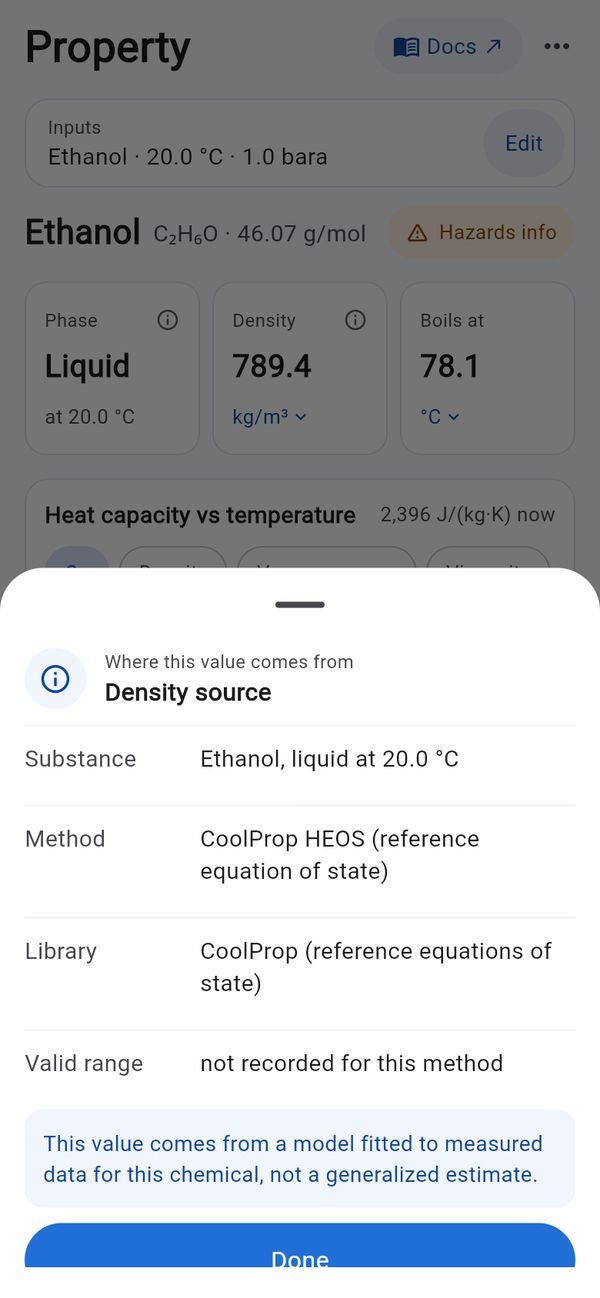
On the Property results, tap the ⓘ beside a value (Phase, Density, specific heat capacity, vapor pressure, enthalpy of vaporization, enthalpy and Gibbs energy of formation, viscosity, thermal conductivity, surface tension or electrical conductivity). A sheet headed "Where this value comes from" opens, titled after the value, such as Density source. It shows:
| Row | What it says |
|---|---|
| Substance | The chemical and the state the value is for, such as "Ethanol, liquid at 20.0 °C". |
| Method | The correlation or model that gave the value, such as "CoolProp HEOS (reference equation of state)". |
| Source | Which data source or family of methods it belongs to (see Where the data come from). |
| Valid range | The temperature range the method was fitted over, in your temperature unit, or "not recorded for this method". |
Where a range is known, a line under it says whether your temperature is inside it. Outside, the line is amber: the value is extrapolated.
A note at the foot says what kind of value it is. Most say the value comes from a correlation, or a model, fitted to measured data for this chemical rather than a generalized estimate. The enthalpy and Gibbs energy of formation also give their reference condition: 298.15 K (25 °C) and 1 bara, with each element in its standard reference state at zero, so these values do not change with the temperature and pressure you entered.
When a value is low-confidence, the sheet is titled with "accuracy" instead of "source", such as Density accuracy (Phase accuracy rather than Phase determination), and its icon and note are amber, saying what limits the value.
Changing a property's method
For vapor pressure, specific heat capacity, viscosity, thermal conductivity, enthalpy of vaporization and surface tension, the sheet ends with Change method when more than one method is available for that chemical. Each method shows its source and valid range; methods whose range covers your temperature come first, and ranges your temperature falls outside are in amber. The method in use has a tick.
Tap another method and the properties are calculated again with it. Once you have picked one, Use the app's default goes back to the app's own choice. A picked method lasts until you look up a different substance, which starts from the app's own choices again; it is not part of a saved set.
One enthalpy reference
Enthalpy is a state function: the heat to take a substance from one state to another is its enthalpy at the end minus its enthalpy at the start, whatever happens on the way. So wherever a calculation crosses a phase (Heater, Heat Exchanger, Phase Equilibrium, mixing streams, a solid depositing), both ends are put on one reference: each phase's heat-capacity curve, joined to the next phase by the enthalpy difference between the two phases. That difference is taken from the best data on record, in this order:
- A measured value of that very difference: the heat of fusion, the heat of vaporisation, or a measured heat of sublimation (NIST WebBook, Gharagheizi).
- The difference of the two phases' enthalpies of formation, but only when both come from one evaluated compilation (CRC, NIST WebBook, JANAF, ATcT, API) and the difference is positive. Across about 2,000 substances in the catalogue, pairs taken from two sources or from a group-contribution estimate were off by a median of 40 to 90 %; pairs from one compilation are reliable for the inorganic solids where no measured value exists, such as ZrCl₄ and ZrI₄.
- The slope of a measured sublimation-pressure curve, by Clapeyron: ΔH_sub = R T² d(ln P_sub)/dT. CO₂ gets 25.8 kJ/mol at −78.5 °C this way (measured 25.2 to 26.1).
- An estimate, the heat of fusion plus a heat of vaporisation extrapolated to the melting point. The result then says it is an estimate.
A difference at 25 °C is carried to the transition temperature along the same heat-capacity curves (Kirchhoff), so the latent heat and the sensible heat on either side cannot disagree.
The sublimation-pressure curve follows the same rule. Where no measured curve exists, the app rebuilds it by Clapeyron from the triple point with the heat of sublimation above, instead of a curve built from the estimate.
Reaction, Electrochemical Reaction and Chemical Equilibrium already work this way: each species' enthalpy is its enthalpy of formation in the phase picked, plus its heat capacity.
Methods used
Most results end with a Methods used row: "See or change how this was calculated". Tap it to open a sheet listing what the result was calculated with. Where there is another method to pick, its choices sit under it as chips; tap one and the result is calculated again with it. Where there is nothing to pick, the sheet only says what was used.
| Calculation | What the sheet lists | What you can change |
|---|---|---|
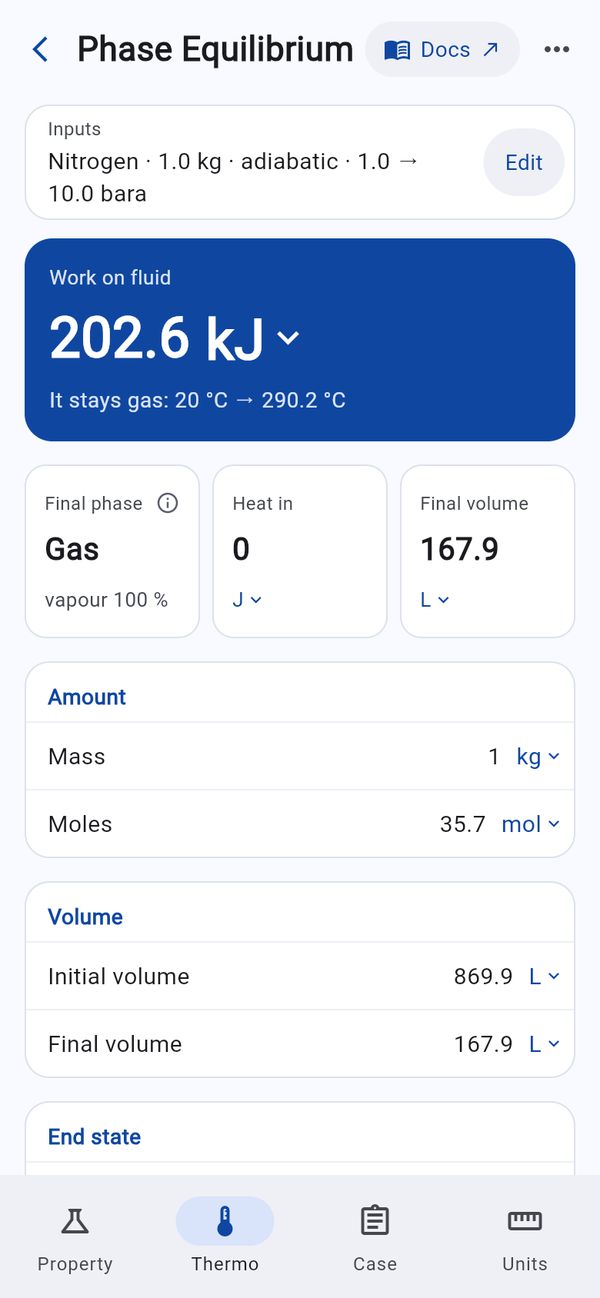
| Phase Equilibrium | Equation of state | For a single substance with a CoolProp reference equation: Reference equation (CoolProp) (the default) or Peng-Robinson cubic. A mixture has nothing to pick: a liquid that hydrogen bonds uses an activity-coefficient model (NRTL with fitted pair data, otherwise UNIFAC, marked Estimated), and other mixtures use Peng-Robinson with fitted interaction parameters where they exist and ideal mixing where they do not. |
| Chemical Equilibrium | Method (Gibbs energy minimisation over the allowed species) and Species data, the source of each species' data | Nothing; what changes the answer is which species are allowed |
| Reaction, Electrochemical Reaction | Method (ΔH, ΔG and K from each species' formation data at the reaction temperature) and Thermochemical data, one record per species | Nothing; each species has one record |
| Heater, Heat Exchanger | Heat capacity for each phase of each substance (on the Heat Exchanger, of the hot and the cold stream) | The heat-capacity correlation for that phase, where there is more than one. A mixture uses ideal mixing of each component's own correlations, with nothing to pick. For a fluid, the duty itself is the enthalpy difference from the equation of state, so it holds at high pressure too; the heat capacity is shown for checking by hand. |
| Heater, sealed vessel | Equation of state for the substance | Reference equation (CoolProp) or Peng-Robinson cubic, for a substance with a reference equation |
The Fluidized Bed has no Methods used row, and on Property each value's method is changed from its own ⓘ sheet instead.
The reference equation is the most accurate where it exists; Peng-Robinson is the general cubic the app uses for everything else. Picking Peng-Robinson for a substance with a reference equation is a way to see how much the choice of model moves the answer. Like a method picked on Property, a pick here is not part of a saved set.
How accurate it is
Accuracy and limits lists what each method was checked against and how far off it was.
References
One list of the books, papers and data sources the app relies on, grouped by subject and in alphabetical order within each group. Each module's page has its own References section that says which relation each one supports. Page numbers are left out.
Equations of state and phase equilibrium
- Bell, I. H., Wronski, J., Quoilin, S. and Lemort, V., "Pure and pseudo-pure fluid thermophysical property evaluation and the open-source thermophysical property library CoolProp", Industrial & Engineering Chemistry Research 53, 2014.
- ChemSep, database of binary interaction parameters for Peng-Robinson and of NRTL pair parameters.
- DDBST, UNIFAC group assignment table.
- Fredenslund, A., Jones, R. L. and Prausnitz, J. M., "Group-contribution estimation of activity coefficients in nonideal liquid mixtures", AIChE Journal 21, 1975. UNIFAC.
- Horsley, L. H., Azeotropic Data, as tabulated in the CRC Handbook. Azeotrope comparison data.
- IUPAC-NIST Solubility Data Series. Mutual solubility of water and hydrocarbons, comparison data.
- Kunz, O. and Wagner, W., "The GERG-2008 wide-range equation of state for natural gases and other mixtures", Journal of Chemical & Engineering Data 57, 2012. The type of reference mixture equation used to check light gas mixtures.
- McCabe, W. L., Smith, J. C. and Harriott, P., Unit Operations of Chemical Engineering. Benzene and toluene comparison data.
- Peng, D.-Y. and Robinson, D. B., "A new two-constant equation of state", Industrial & Engineering Chemistry Fundamentals 15, 1976.
- Perry's Chemical Engineers' Handbook, McGraw-Hill. Methanol and water vapour-liquid data, table 13-1, as comparison data.
- Renon, H. and Prausnitz, J. M., "Local compositions in thermodynamic excess functions for liquid mixtures", AIChE Journal 14, 1968. NRTL.
- Smith, J. M., Van Ness, H. C., Abbott, M. M. and Swihart, M. T., Introduction to Chemical Engineering Thermodynamics, 8th ed., McGraw-Hill, 2018.
- Span, R. and Wagner, W., "A new equation of state for carbon dioxide covering the fluid region from the triple-point temperature to 1100 K at pressures up to 800 MPa", Journal of Physical and Chemical Reference Data 25, 1996.
- Wagner, W. and Pruss, A., "The IAPWS formulation 1995 for the thermodynamic properties of ordinary water substance for general and scientific use", Journal of Physical and Chemical Reference Data 31, 2002. IAPWS-95.
- Wagner, W. et al., "The IAPWS Industrial Formulation 1997 for the Thermodynamic Properties of Water and Steam", Journal of Engineering for Gas Turbines and Power 122, 2000. IAPWS-IF97, the steam tables used as comparison data.
Thermochemical data
- Active Thermochemical Tables (ATcT), Argonne National Laboratory. One of the evaluated compilations behind the enthalpies of formation.
- Barin, I., Thermochemical Data of Pure Substances, 1997. Cement clinker minerals, magnetite and calcite.
- Chase, M. W., Jr., NIST-JANAF Thermochemical Tables, 4th ed., Journal of Physical and Chemical Reference Data, Monograph 9, 1998.
- CRC Handbook of Chemistry and Physics, CRC Press. Enthalpies of formation, entropies, heat capacities, phase-change data and the inorganic decomposition table.
- Feistel, R. and Wagner, W., "A new equation of state for H2O ice Ih", Journal of Physical and Chemical Reference Data 35, 2006. IAPWS-06, the heat capacity of ice.
- Gharagheizi et al., enthalpy of sublimation data set.
- Giauque, W. F. and Egan, C. J., Journal of Chemical Physics 5, 45 (1937). Measured heat capacity of dry ice.
- Gordon, S. and McBride, B. J., Computer Program for Calculation of Complex Chemical Equilibrium Compositions and Applications. I. Analysis, NASA Reference Publication 1311, 1994.
- Hanein, T., Glasser, F. P. and Bannerman, M. N., "Thermodynamic data for cement clinkering", Cement and Concrete Research 132, 2020. Tetracalcium aluminoferrite.
- Lastovka and Shaw, group-contribution estimate of solid heat capacity. Used only where no measured heat capacity exists, and the result says so.
- McBride, B. J. and Gordon, S., Computer Program for Calculation of Complex Chemical Equilibrium Compositions and Applications. II. Users Manual and Program Description, NASA Reference Publication 1311, 1996. Describes the thermodynamic data file format.
- McBride, B. J., Zehe, M. J. and Gordon, S., NASA Glenn Coefficients for Calculating Thermodynamic Properties of Individual Species, NASA/TP-2002-211556, 2002.
- NIST Chemistry WebBook, NIST Standard Reference Database 69. Phase-change enthalpies, heat capacities and the plastics data below.
- Plastics heat capacities: NIST WebBook (Chang 1976; Chang and Bestul 1973), Wunderlich (1990, ATHAS report), Grebowicz et al. (1984), Passaglia and Kevorkian (1963) and Dainton et al. (1962), as cited in the app's polymer data.
- Wagner, W. et al. (2011), IAPWS equation for the sublimation pressure of ice, used as comparison data.
- NASA CEA thermodynamic data file (Apache License 2.0), for the NASA Glenn polynomials.
Transport and physical properties
- DIPPR property correlations (AIChE Design Institute for Physical Properties).
- Laliberté, M., "A model for calculating the heat capacity of aqueous solutions, with updated density and viscosity data", Journal of Chemical & Engineering Data 54, 2009. The fitted model for density, heat capacity and viscosity of aqueous solutions. It builds on Laliberté, M. and Cooper, W. E., "Model for calculating the density of aqueous electrolyte solutions", Journal of Chemical & Engineering Data 49, 2004.
- Lange's Handbook of Chemistry. Tabulated measured values used on the Property tab.
- Lovdata, forskrift om tiltaks- og grenseverdier, vedlegg 1 (Norway), licence NLOD 2.0. Exposure limits. Ontario limits come from O. Reg. 833.
- Perry's Chemical Engineers' Handbook, as above. Heat capacity of brine and the enthalpy-concentration chart for sulfuric acid, as comparison data.
- Poling, B. E., Prausnitz, J. M. and O'Connell, J. P., The Properties of Gases and Liquids, 5th ed., McGraw-Hill, 2001.
Reaction engineering
- Fogler, H. S., Elements of Chemical Reaction Engineering, Prentice Hall. The default Reactor example.
- Larson, A. T. and Dodge, R. L., Journal of the American Chemical Society, 1923 and 1924. Measured ammonia equilibrium at 450 °C.
- Levenspiel, O., Chemical Reaction Engineering, 3rd ed., Wiley, 1999.
- Smith, W. R. and Missen, R. W., Chemical Reaction Equilibrium Analysis: Theory and Algorithms, Wiley, 1982.
Fluidization
- Abrahamsen, A. R. and Geldart, D., "Behaviour of gas-fluidized beds of fine powders, Part I: Homogeneous expansion", Powder Technology 26, 1980. Minimum bubbling velocity.
- Darton, R. C., LaNauze, R. D., Davidson, J. F. and Harrison, D., "Bubble growth due to coalescence in fluidised beds", Transactions of the Institution of Chemical Engineers 55, 1977.
- Davidson, J. F. and Harrison, D., Fluidised Particles, Cambridge University Press, 1963.
- Ergun, S., "Fluid flow through packed columns", Chemical Engineering Progress 48, 1952.
- Geldart, D., "Types of gas fluidization", Powder Technology 7, 1973.
- Geldart, D., Cullinan, J., Georghiades, S., Gilvary, D. and Pope, D. J., "The effect of fines on entrainment from gas fluidised beds", Transactions of the Institution of Chemical Engineers 57, 1979. Elutriation, as given in Kunii and Levenspiel.
- Zenz, F. A. and Weil, N. A., "A theoretical-empirical approach to the mechanism of particle entrainment from fluidized beds", AIChE Journal 4, 1958. Transport disengaging height, which the app does not calculate.
- Haider, A. and Levenspiel, O., "Drag coefficient and terminal velocity of spherical and nonspherical particles", Powder Technology 58, 1989.
- Kunii, D. and Levenspiel, O., Fluidization Engineering, 2nd ed., Butterworth-Heinemann, 1991.
- Wen, C. Y. and Yu, Y. H., "A generalized method for predicting the minimum fluidization velocity", AIChE Journal 12, 1966.
Electrochemistry
- Bard, A. J. and Faulkner, L. R., Electrochemical Methods: Fundamentals and Applications, 2nd ed., Wiley, 2001.
- CODATA recommended values. The Faraday constant, exact since the 2019 redefinition of the SI units.
Software libraries
- CoolProp 7.2.0 (Bell et al. 2014, above). Reference equations of state.